Course Changes
Course Inventory Management (CIM)
Adjustments to course offerings are processed via the online Course Inventory Management (CIM). Users may log into CIM and submit proposals to add, change, reactivate or delete courses in the existing course inventory. Once submitted, the proposal advances through a series of approval steps which include college and university-level consents. Since the approval process varies in length (depending on the specific changes requested), course changes of a substantial nature should be submitted in early fall to allow ample time to complete the approval process. All proposals must be approved by the Faculty Senate before or during the March meeting in order to be included in the next year's catalog (generally changes will not be effective until they are reflected in the Catalog of Studies). After approval, changes are recorded in the course inventory by the Office of the Registrar and take effect in the Schedule of Classes with the next applicable term.
If new courses are required to support a new degree program that is being proposed through the program change process, proposals for course and program change must be submitted concurrently.
For more information regarding the Course Change Approval Process, please see Academic Policy Series 1622.10.
This online process is designed to automate the university's curriculum change process while preserving the existing approval structure. Approvers will be notified of changes awaiting their review and response, and users will be able to track the progress of course change requests as they move through the approval process.
Course proposals submitted in CIM follow a set approval process, based on the type of change(s) requested. The approval process is abbreviated for minor changes. Major changes, however, require the full completion of approval steps. Such changes require several months to complete the approval process.
To submit a course change proposal, please log in to the Course Inventory Management (CIM) system.
To approve a course change proposal, please log in to the CIM Approval page.
The following chart provides an overview of course changes by type and allowable effective terms. See the links below for additional details.
|
Course Change Proposals |
||
|---|---|---|
| Change Type | Fall Semesters | Spring and Summer Semesters |
| Minor Changes | ||
|
Minor Title Update
|
Allowed |
Allowed |
| Minor Course Description Update | Allowed | Allowed |
| Course Numbering (Non-Credit Hour/Level) | +Allowed | Not Allowed |
| Requisites | Allowed | Allowed |
| Add/Remove Labs or Drills | +Allowed | +Allowed |
| Subject Codes | Allowed | Not Allowed |
| Variable Credit Hours (Range) | Allowed | Allowed |
| Cross-Listing | Allowed | Allowed |
| Repeatability/Multiple Enroll | Allowed | Allowed |
| Assigning Special Topics | Allowed | Allowed |
| Typically Offered | Allowed | Allowed |
| Delivery Method | Allowed | Allowed |
| Component Type | +Allowed | +Allowed |
| Course Reactivations | Allowed | Allowed |
| Major Changes | ||
|
Add New Course |
Allowed | Allowed |
| Major Title Update | Allowed | Not Allowed |
| Major Course Description Update | Allowed | Not Allowed |
| Course Numbering (Credit Hour/Level) | +Allowed | Not Allowed |
| Changes to SMC/Gen Ed Courses | Allowed | Not Allowed |
| Inactivations/Deletions | Allowed | Not Allowed |
| Moving Courses from One College/Dept to Another | Allowed | Not Allowed |
| +if no enrollment for effective term | ||
The following actions are considered minor changes and only require an abbreviated approval process:
- Minor stylistic/editorial changes to title or description
- Changes to prerequisites/co-requisites
- Creation/deletion of non-credit labs or drills for existing courses
- Changes to subject alpha codes (e.g. INST to HUMN)
- Changes to course numbering that do not impact level or number of credit hours (e.g. 20103 to 20203)
- Changes to the allowed number of variable hours (e.g. from 1-3 to 1-6)
- Cross-listing to an existing course (e.g. AAST 45603 and HIST 45603)
- Adding/removing repeatability (with or without allowing multiple enrollment in the same term)
- Adding/removing the ability to assign special topics
- Changes to frequency of course offering (e.g. from fall to spring)
- Changes to delivery method (e.g., in-person, or online)
- Changes to component type (e.g. from lecture to applied instruction; will be effective the first term without class enrollment)
Minor changes can, as a rule, be made effective at the beginning of any semester throughout the academic year.
Course reactivation requests follow the same shortened approval process as minor change requests. Minor edits to the course can also be included in the same reactivation proposal, provided the number of changes requested is limited.
Note: Each action listed above qualifies as a minor change by itself, and multiple changes may be submitted in one proposal and still be considered minor changes. However, proposals that substantially change the nature of a course by changing many or all of the items listed above will be processed as a major change and will require the full set of approval steps.
The following chart lists the approval steps associated with minor changes and reactivations:
Minor Changes and Reactivations
- Registrar Initial Review
- Department Chair
- ♦Honors College
- +Global Campus
- College Dean
- *State Minimum Core/General Education Committee
- *Undergraduate or Graduate Council
- *Faculty Senate
- Provost's Office
- Registrar Final
- Workday
- Curriculum Review
♦if Honors course
+if online delivery method is proposed
*if state minimum core or general education course
The following actions are considered major changes and require the full set of college and university-level approval steps:
- Adding a new course/adding an Honors course from an existing non-Honors course
- Major content changes to title or description
- Changes to course numbering that affect level (first digit) or number of credit hours (last digit) (e.g. 10203 to 20203 or 21803 to 21804)
- Changing a course from fixed credit hour to variable credit hour or from variable to fixed (e.g. 40003 to 4000V)
- Adding or removing a course from state minimum core or general education curriculum
- Moving courses from one college/department to another
- Inactivating/deleting a course
Course inactivation and deletion proposals both follow the same approval process, but result in slightly different outcomes. Inactivating a course removes it from the Catalog of Studies and from the list of courses available to be offered each term in the Schedule of Classes. Inactive courses may be reactivated at the request of the college or department by submitting a course reactivation proposal. Deleting a course removes it from the Catalog of Studies and from course inventory permanently. Deleted courses may not be reactivated.
Note: As a rule, new courses, major changes, and inactivations/deletions will only be made effective for the fall term, in order to ensure inclusion in the publication of the Catalog of Studies. Early implementation may be requested in the “Justification” or “Additional Notes” fields when submitting a course change proposal, but approval is not guaranteed.
The following chart lists the approval steps associated with new courses, major changes and inactivations/deletions:
Add New Course, Major Changes and Inactivations/Deletions
- Registrar Initial Review
- College Dean Initial
- Department Chair
- ♦Honors College
- +Global Campus
- Director of Curriculum Review and Program Assessment
- College Curriculum Committee
- College Faculty
- College Dean
- Sr. Vice Provost for Academic Affairs
- *State Minimum Core/General Education Committee
- Undergraduate or Graduate Council
- Faculty Senate
- Provost's Office
- Registrar
- Workday
- Curriculum Review
♦if Honors course
+if online delivery method is proposed
*if state minimum core or general education course
While CIM makes it easy to submit and approve course change proposals, there are several things to be aware of before you get started:
- Faculty and staff can log in to CIM to view and submit course change proposals using a valid uark username and password. However, security to approve course changes in a designated role (department chair, dean’s office, etc.) must be authorized by your college or school.
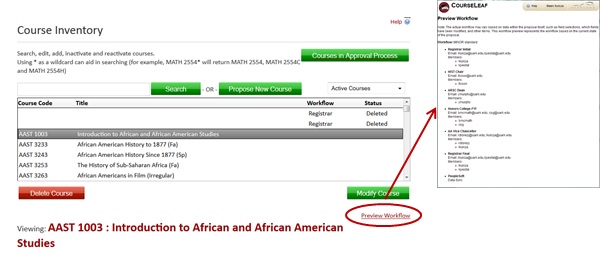
- Although CIM automatically determines the appropriate approval process (major or minor)
based on the changes requested within the edited form, you can preview the potential
workflow steps for any given course change before editing by selecting the course from the CIM window and then clicking on the “Preview Workflow”
link in the upper right hand corner.
- CIM allows users to attach supporting documentation, such as course syllabi, departmental organization charts, etc. In order to save time when submitting proposals, you may wish to have supporting documentation ready as a separate file to facilitate data entry.
- Please review course proposals before submitting them to workflow, as changes to academic level, course number, state minimum core or general education inclusion/exclusion and delivery method cannot be modified once the proposal has been submitted.
- Before proposing a change involving a new college or school, a new department or a new subject code, you must first contact the Office of the Registrar. Otherwise, these options will not be available for selection in the appropriate drop-down menus on the course proposal form.
- Please review the following instructions if you are new to using CIM or new to submitting and/or approving course proposals. You can also contact the Office of the Registrar’s curriculum management team if you have questions about using CIM.